
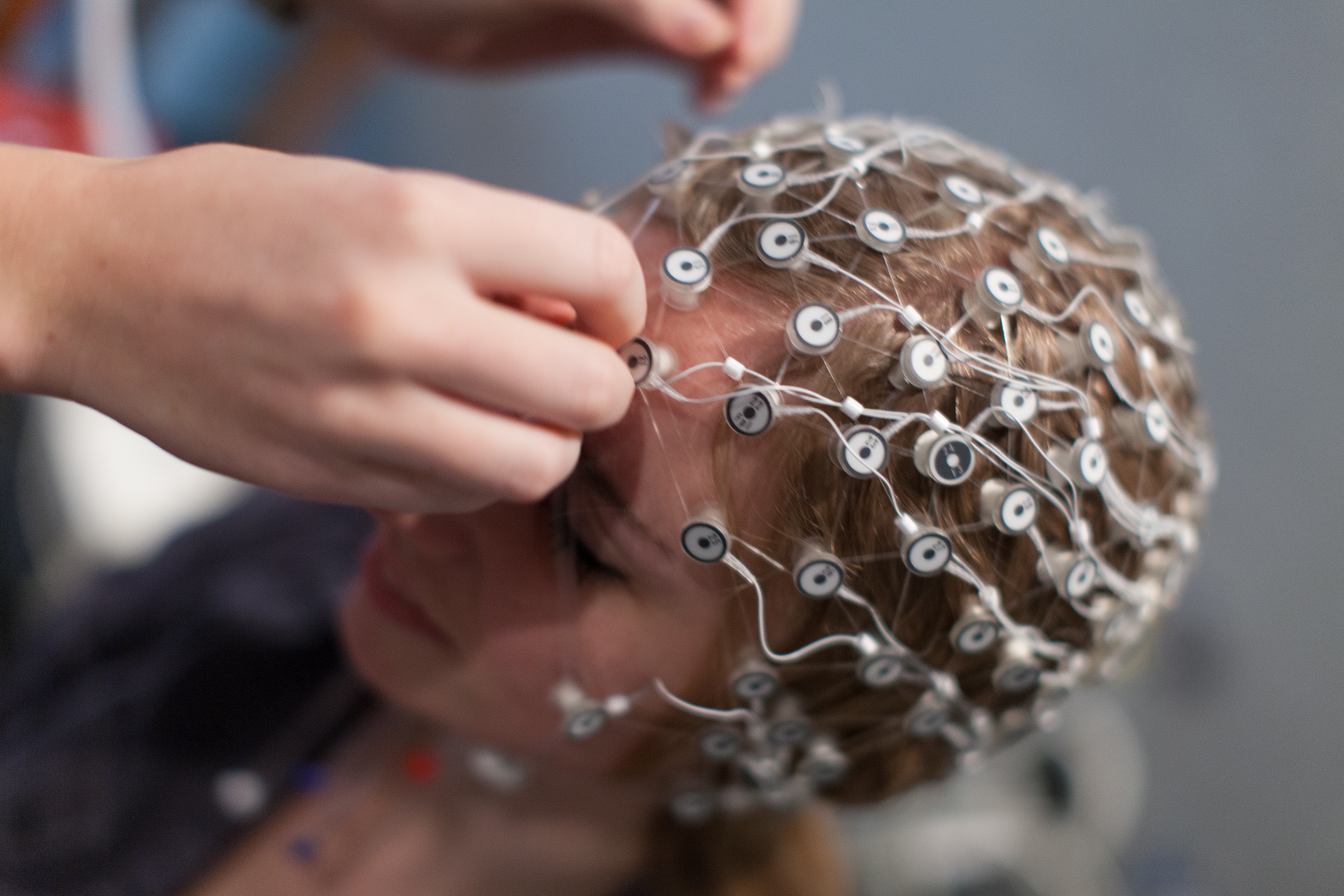
Experience shapes every moment of our lives. Learning about the world includes the formation of memories that link certain situations, people, or objects to good and bad outcomes. For example, is my neighbor’s new puppy friendly or does he bite? Does the new boss give helpful feedback or not so much? Or, and this may be familiar to some, does the ringing of a bell predict food or an electric shock? In the laboratory, association formation is often studied by pairing simple visual stimuli with unpleasant events like loud noises or electric pulses in a process called fear conditioning. This is done because the learning and un-learning of fear through conditioning is a process that is of interest not only for basic neuroscience research, but also for developing new assessments and interventions for mental health problems. Our laboratory characterizes how the human brain and body acquire and eventually unlearn new fear memories. To do this, we use combine simultaneous measurements from several physiological systems, including Electroencephalography (EEG), Electrocardiography (ECG), cerebral blood flow (fMRI), and pupillometry, combined with computational modeling and advanced analytical techniques such as machine learning. This allows us to characterize—in time and space—how the brain changes and how the body adapts as people learn about fearful situations. One main outcome of our work is that many more brain regions participate in adaptive learning than was previously thought. In particular, neurons that represent the visual world change their sensitivity as learning progresses, to provide a sharper view of threatening or dangerous scene elements.