
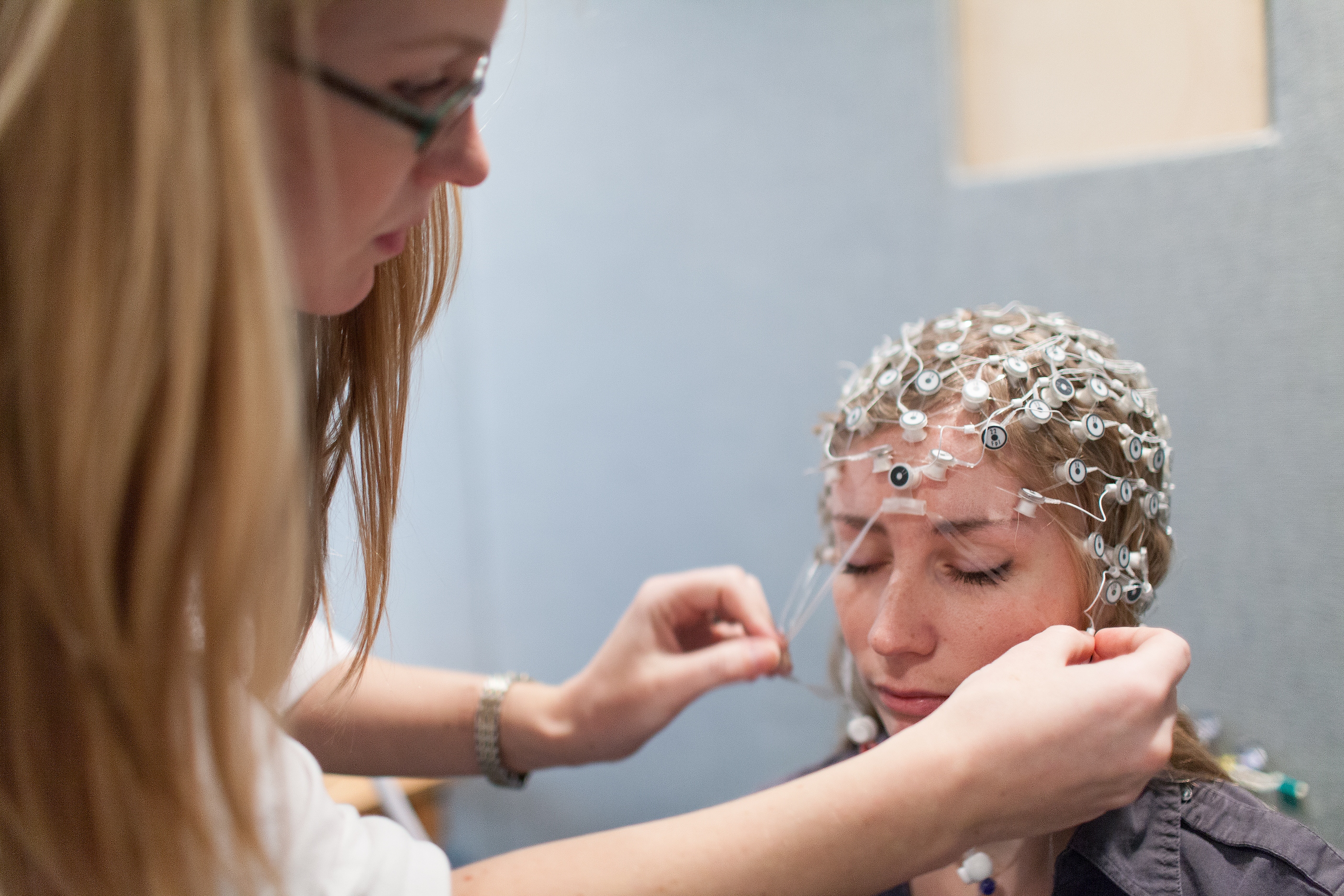
Dense-array EEG
Dense-array electroencephalography captures millisecond-scale changes in cortical activity during perception, attention, emotion, and associative learning.
The lab combines non-invasive brain recording, pupillometry, autonomic and behavioral measures, experimental learning paradigms, and quantitative analysis to study rapid changes in perception, attention, emotion, and learning.
Dense-array electroencephalography captures millisecond-scale changes in cortical activity during perception, attention, emotion, and associative learning.
Pupil and gaze measures provide sensitive indices of attention, autonomic engagement, and changes in visual processing during learning.
Aversive conditioning allows the lab to examine how initially neutral sensory cues acquire motivational relevance through experience.
Frequency-domain, time-frequency, and mass-univariate methods are used to quantify neural dynamics without reducing complex signals to a single latency or sensor.
Behavioral responses, autonomic activity, and self-report complement brain-based measures by capturing performance, bodily response, and subjective experience.
Neural, autonomic, oculomotor, and behavioral measures provide complementary information. Aligning these signals in time helps identify what changes, when it changes, and how strongly those changes vary across people and experimental conditions.