Skip to main content Screen Reader Website Version
Research Methods

Methods for measuring how brain, body, and behavior change together.

The lab combines non-invasive brain recording, pupillometry, autonomic and behavioral measures, experimental learning paradigms, and quantitative analysis to study rapid changes in perception, attention, emotion, and learning.

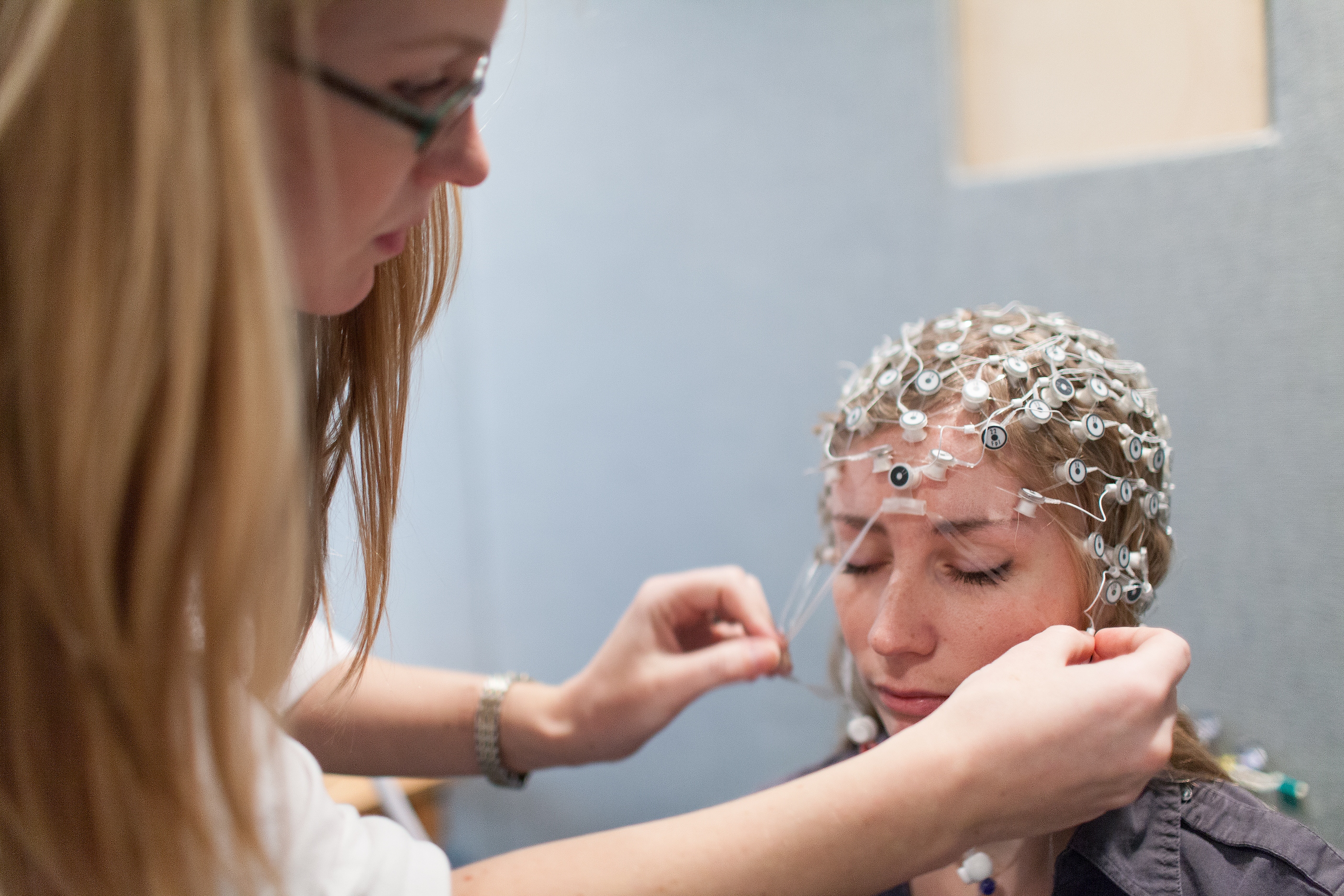
Researcher preparing a participant for dense-array EEG recording
Neural Electrophysiology

Dense-array EEG

Dense-array electroencephalography captures millisecond-scale changes in cortical activity during perception, attention, emotion, and associative learning.

MeasureEEG / ERP / oscillatory activity RecordingHigh-density scalp EEG
AnalysisEvent-related potentials, steady-state responses, spectral power, time-frequency analysis, and spatially resolved statistical testing.
Oculomotor Measurement

Pupillometry & eye tracking

Pupil and gaze measures provide sensitive indices of attention, autonomic engagement, and changes in visual processing during learning.

MeasurePupil diameter / gaze RecordingInfrared eye tracking / pupillometry
AnalysisPupil dilation, gaze position, fixation, microsaccades, and time-locked responses.
Experimental Paradigm

Aversive conditioning

Aversive conditioning allows the lab to examine how initially neutral sensory cues acquire motivational relevance through experience.

MeasureAssociative learning / threat discrimination RecordingControlled visual or auditory stimulus presentation
AnalysisAcquisition, discrimination, generalization, extinction, and trial-level changes in neural, pupil, autonomic, and behavioral responses.
Quantitative Analysis

Quantitative EEG analysis

Frequency-domain, time-frequency, and mass-univariate methods are used to quantify neural dynamics without reducing complex signals to a single latency or sensor.

MeasureSpectral / time-frequency / mass-univariate EEG RecordingReproducible computational workflows
AnalysisFrequency-domain analysis, time-frequency decomposition, mass-univariate statistics, simulations, and participant-level effect estimation.
Psychophysiology

Behavioral & autonomic measurement

Behavioral responses, autonomic activity, and self-report complement brain-based measures by capturing performance, bodily response, and subjective experience.

MeasureBehavior / autonomic reactivity / self-report RecordingBehavioral tasks and psychophysiological recording
AnalysisResponse accuracy and timing, autonomic reactivity, subjective ratings, and individual-difference measures.
Multimodal Measurement

Multiple signals can reveal different parts of the same response.

Neural, autonomic, oculomotor, and behavioral measures provide complementary information. Aligning these signals in time helps identify what changes, when it changes, and how strongly those changes vary across people and experimental conditions.