
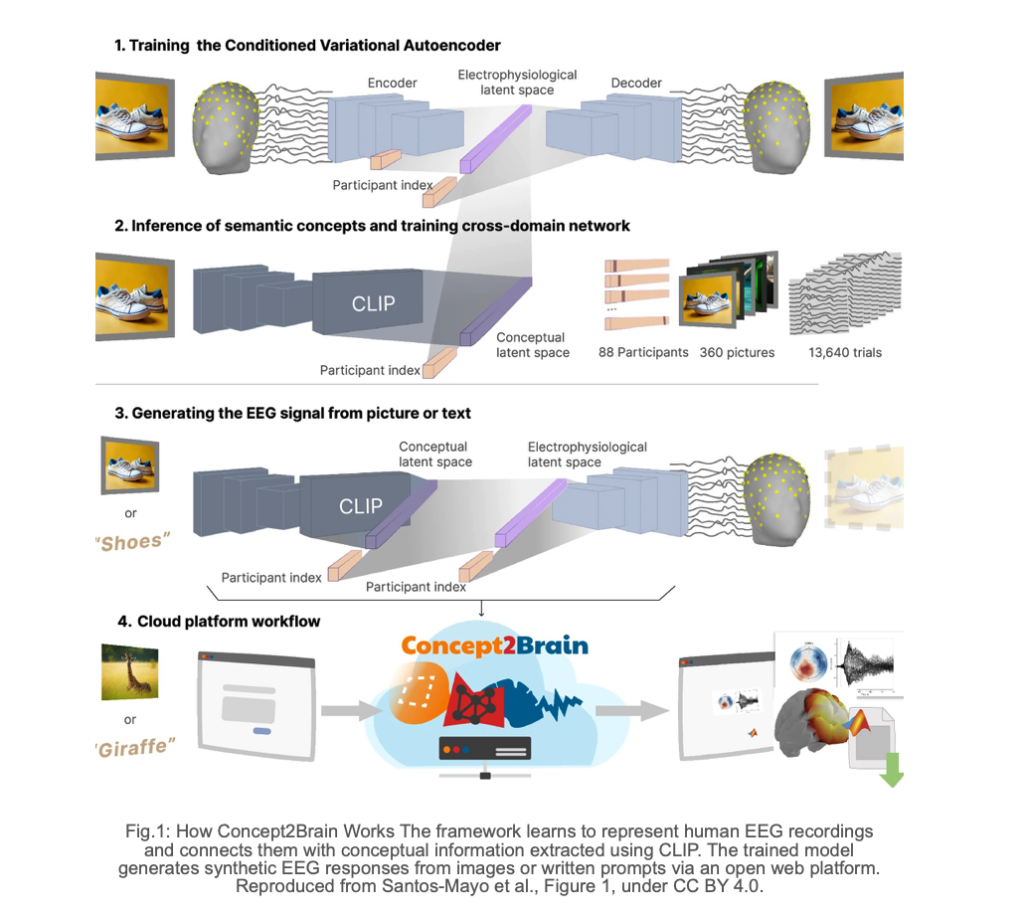
Researchers from the University of Florida’s Brain, Body, and Behavior Lab contributed to the development of Concept2Brain, an artificial intelligence model that generates synthetic electroencephalographic (EEG) responses from photographs and text-based prompts. The study, published in Nature Communications, introduces a framework for connecting conceptual information with patterns learned from human brain recordings. The framework could help researchers explore hypotheses and plan experiments by simulating aspects of EEG responses before collecting new data.
EEG measures electrical activity at the scalp, enabling researchers to examine brain responses on a millisecond timescale. Instead of decoding recorded activity to determine what someone is viewing, Concept2Brain operates in reverse. It uses information about a stimulus to predict the associated EEG response. These predicted responses resemble event-related potentials (ERPs), which are waveforms derived by averaging EEG responses synchronized to repeated events or stimuli.
Read the study, Concept2Brain: an AI model for predicting neurophysiological responses to text and pictures, by Santos-Mayo, A., Gilbert, F., Mirifar, A., Tebbe, A.-L., Fang, R., Ding, M., and Keil, A.
Explore the platform: Concept2Brain.